Manufacturing & Quality
How we work — and what we will not claim.
This page sets out the materials we mould, the sequence an order moves through, and an explicit list of the capabilities we do not have. A buyer qualifying a new supplier needs both halves of that picture.
- 4
- Rubber grades
- 3+
- Plastic grades
- 1,000
- Lowest MOQ
- 4
- Packaging
What we actually mould
Every row below is drawn from the specification fields on our own product listings. It is a record of what has gone through the works, not a statement of ambition.
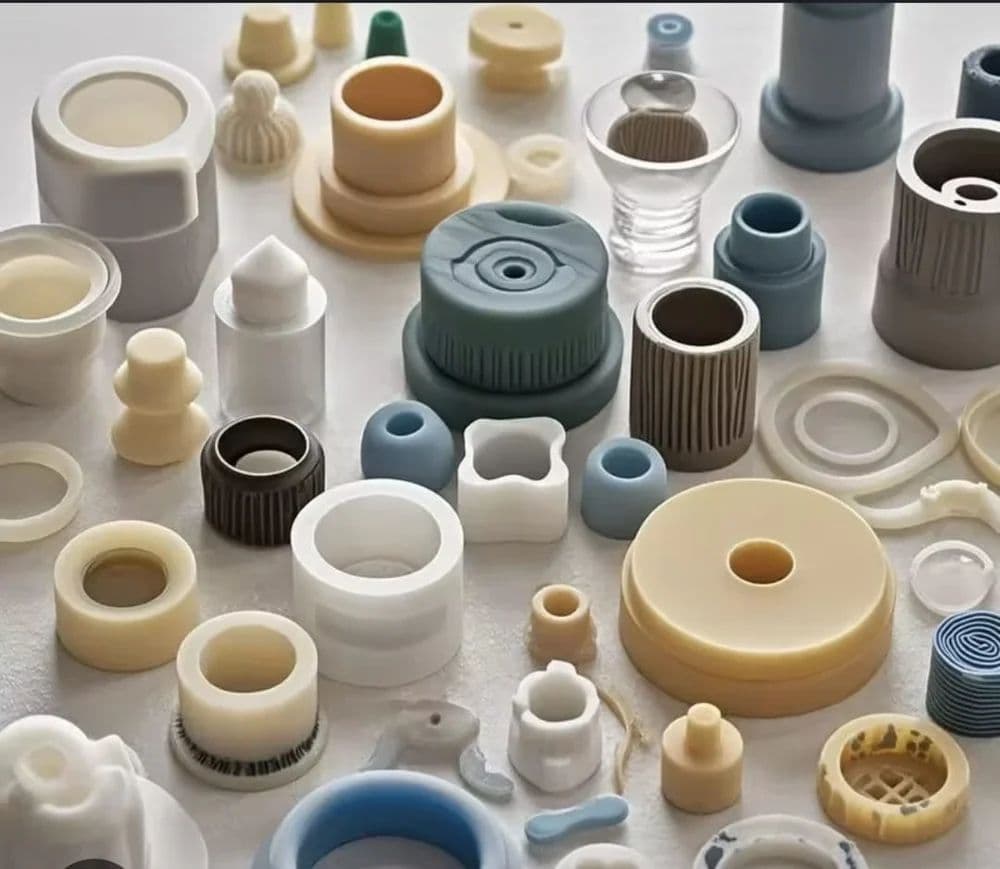
| Business type | Manufacturer |
|---|---|
| Moulding materials — rubber | Silicone, Natural, EPDM, Nitrile (NBR) |
| Moulding materials — plastic | PVC, Nylon, engineering plastics |
| Inserts | Metal bush inserts for plastic parts |
| Build to requirement | Size, thickness, weight, colour customised |
| Minimum order quantity | 1,000 – 50,000 pieces, by listing |
| Packaging formats | Packet, Polybag, Box, Carton |
| Country of origin | Made in India |
| Dispatch from | Mathura, Uttar Pradesh |
Materials
- Silicone rubber
- Natural rubber
- EPDM rubber
- Nitrile (NBR)
- PVC
- Nylon
- Engineering plastics
- Metal inserts for plastic
Packaging
- Packet
- Polybag
- Box
- Carton
Packed to the format agreed for your order. Tell us how it arrives at your line.
From enquiry to dispatch
Six stages, described as they actually happen. Where a stage has a limit worth knowing about, we say so inside the stage rather than in small print.
Requirement discussion
We start from the duty, not the part number. What does the component sit between, what does it have to survive — temperature, oil or water contact, movement, clamp load — and how many do you need. If you are working from a part that already exists, a photograph and a caliper reading is usually enough to begin.
Output
A clear statement of the application
Product specification
We fix material, hardness, inner and outer diameter, section thickness and colour against that duty. Where a catalogue listing is close but not exact, we tell you which dimensions can change and which cannot. For the build-to-requirement lines, this step works from your drawing, dimension sheet or sample part.
Output
An agreed specification
Quotation
You receive a price against your specification and quantity, with the minimum order and the packaging format stated plainly. Pricing is quotation-based throughout — we do not publish unit prices on this site, because a price that ignores your volume and specification is not useful to either of us.
Output
A written price and MOQ
Production
Parts are moulded in the agreed material at the agreed quantity. Across the catalogue we mould in silicone, natural, EPDM and nitrile rubber, and in PVC, nylon and engineering plastics, and we fit metal bush inserts into plastic parts where the housing needs a hard bore.
Output
Parts to specification
Checking before dispatch
Parts are checked against the agreed specification before they are packed. We check dimensions and finish against what was quoted. We want to be exact about the limits of this: it is in-house visual and dimensional checking by the people who made the part, not instrumented inspection against a documented sampling plan.
Output
Parts checked against the quote
Packing, dispatch & support
Parts are packed in the format agreed for the order — packet, polybag, box, carton — and dispatched from Mathura. The order is coordinated through our team directly, so if something needs chasing you are speaking to the people who can resolve it.
Output
Delivered and accounted for
What we do not claim
Most supplier websites are a list of capabilities. This is the other list. We publish it because a buyer who finds out later has every right to distrust everything else we said.
No certifications
We hold no ISO, IATF, RoHS or REACH certification and claim none. If your approval process requires certified supply, tell us at the enquiry stage.
No laboratory testing
We do not operate a materials laboratory, and we do not issue test certificates, material certificates or batch traceability documentation.
No automated inspection
Checking before dispatch is in-house, visual and dimensional. There is no automated or instrumented inspection line, and no documented sampling plan.
No export operation
We supply within India. Some third-party directory listings auto-generate the word “exporter” against our profile; that is their template, not our claim.
No stated capacity figures
We do not publish production capacity, machine counts, factory area or headcount. Ask about a specific volume and we will answer against that volume honestly.
No named customers
We do not display client logos or name the companies we supply. Any supplier that shows you logos it has no permission to use is telling you something about itself.
If any of the above rules us out for your application, we would rather know at the enquiry stage than after a sample. Tell us what your approval process requires and we will give you a straight answer.
Ask us directlyNext Step
Send us the duty, and we\u2019ll specify the part.
Temperature, media contact, movement, load and quantity — that is usually all we need to come back with a specification and a price.
Or speak to us directly — +91 79493 06506